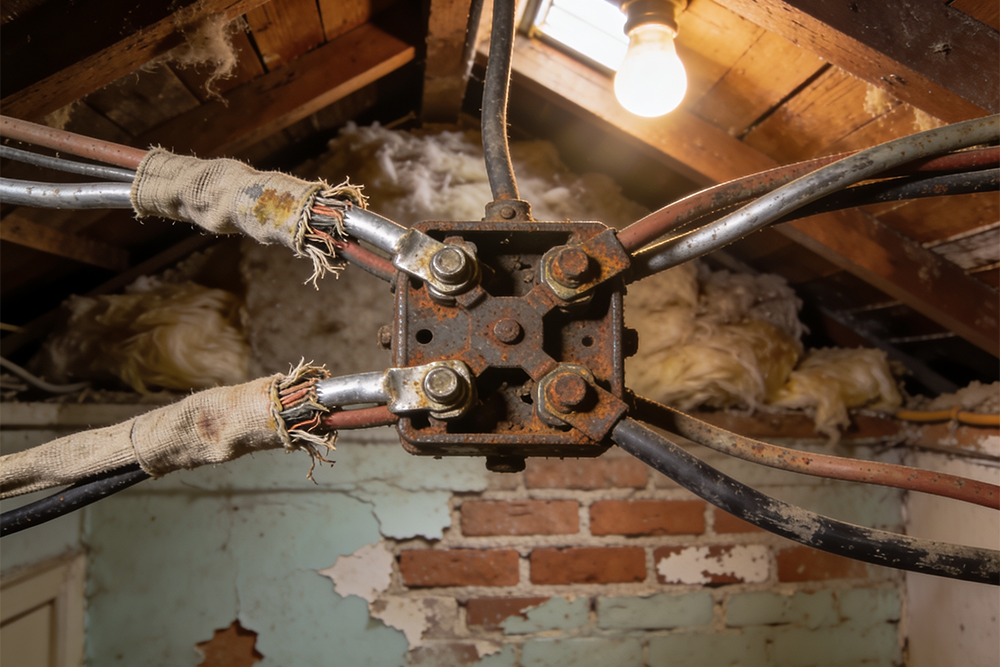
The panel gets most of the attention, but the wiring running through the walls of an older home can be just as dangerous and far harder to see. Across Winter Park, Orlando, and the older parts of Casselberry and Apopka, we regularly find wiring methods that were normal when the home was built and are now a genuine safety concern. Here are the three we watch for most closely.
Knob and Tube Wiring
Knob and tube wiring is still present in some homes built before the 1940s. The insulation is cloth or early rubber, and after 80 or more years it becomes brittle and cracks from age and vibration alone. The bigger issue is that knob and tube was designed to run through open air so heat could dissipate. When a later owner blew insulation into the attic over it, they created a heat trap the system was never meant to handle. Many insurers will no longer cover a home with active knob and tube.
Aluminum Branch Circuit Wiring
Aluminum branch circuit wiring is common in homes built roughly between 1965 and 1973, when copper prices spiked. The wire itself is not the danger. Aluminum expands and contracts more than copper as it heats and cools, and over decades that movement loosens the connections at outlets, switches, and fixtures. Those loose connections oxidize and begin to arc. The warning signs include warm outlets, lights that flicker on one circuit, or the smell of hot plastic near a device that has been in use. The fix is at the connection points, not necessarily the whole run, which we will come back to.
Ungrounded Two Wire Systems
Anything wired before roughly 1960 may have a two wire system with no ground, which you will recognize by the two prong outlets throughout the home. With no ground, a fault inside an appliance has no safe path to follow except through the person who touches it. Worse, some homes have had three prong outlets installed on two wire circuits without an actual ground run to them, which gives a false sense of safety that is arguably more dangerous than the original two prong outlet.
Other Aging Wiring Problems
A few more conditions show up often enough to mention.
- Wire insulation in attics that has dried, cracked, or fallen away, sometimes leaving bare copper exposed near framing or insulation.
- Junction boxes without covers in attics, closets, and crawl spaces, where open connections sit directly against insulation.
- Extension cords used as permanent wiring, which tells you the circuits were never adequate for how the home is actually used.
- Homes with multiple additions wired by different hands to different codes, where every transition between old and new wiring is a connection point that may not have been done right.
You Do Not Always Need a Full Rewire
Homeowners often hear that aluminum wiring or old wiring means tearing the house apart for a complete rewire. New copper throughout is the gold standard, but it is not the only safe path. For aluminum branch wiring in particular, listed connectors installed at every connection point can correct the actual failure mechanism without opening walls. The right answer depends on what your home actually has, which is why an honest inspection comes first. When a full whole home rewiring is the better call, we explain exactly why.
Have Your Wiring Evaluated
If your home is more than 40 years old and has never been rewired, an electrical inspection is the smartest starting point. Spectrum Electric serves Apopka, Orlando, Casselberry, and the surrounding cities, and we give you a clear written picture rather than a scare tactic. Call 407.880.8977 or request an inspection.