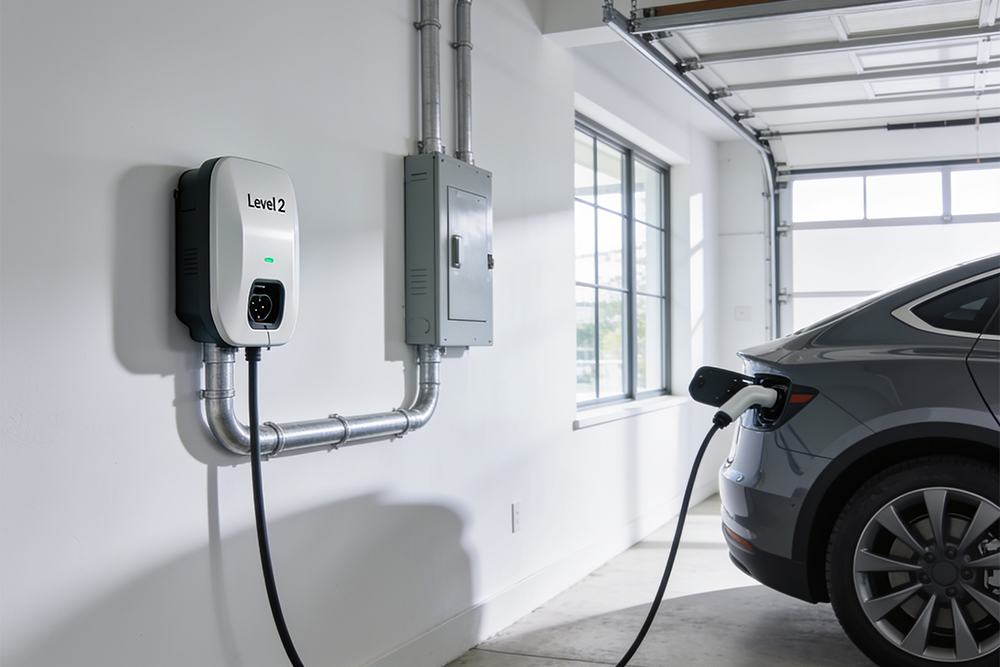
Electric vehicles are now common across Central Florida, and the first thing most new owners want after the dealership is a Level 2 charger in the garage. What surprises people is that the charger itself is often the simplest part of the job. The real conversation starts at the panel, and getting that part right is what keeps the installation safe for years of daily charging.
Why EV Charging Stresses the Panel
A Level 2 charger draws roughly 32 to 50 amps continuously, and continuously is the key word. A microwave runs for two minutes. An EV charger runs for four to eight hours at a stretch, often overnight. That sustained draw changes the entire load picture of the home. Many homes built before the 1990s were designed with 100 amp or 150 amp service sized for the loads of that era. Add an air conditioner, an electric dryer, a water heater, and a modern kitchen, and there may be very little headroom left for a 50 amp charger.
It Starts With a Load Calculation
The first thing our team does on an EV charger consultation is a load calculation, which is an actual measurement of the home's existing demand against the rated capacity of the panel. That is not a guess. It tells us whether the panel can support the new circuit as it stands, whether a load management device makes sense, or whether the panel needs to be upgraded first. In older Orlando and Winter Park homes, the EV conversation often leads to a service upgrade from 100 to 200 amps that was overdue anyway. A 200 amp service leaves room for the charger, future additions, and whole home surge protection.
What the Installation Involves
Once the panel is confirmed, the install runs a dedicated 240 volt circuit from the panel to the garage, typically a 50 amp circuit on 6 gauge wire that supports full speed Level 2 charging. Some homeowners prefer a hardwired charger, others a dedicated 240 volt outlet, and that choice usually comes down to whether they want flexibility to swap chargers or a cleaner permanent setup. The circuit gets its own properly sized breaker, conduit routed through the wall or attic, and a weatherproof or indoor rated connection point. Everything is permitted, inspected, and done to current code.
Why Permitted, Professional Installation Matters
This is one install where doing it right is not optional. The U.S. Fire Administration, part of FEMA, advises that older home wiring is often unsuitable for EV charging equipment and recommends a new dedicated circuit installed by a qualified electrician. The failure points on a bad install are consistent: undersized wire that cannot handle the sustained amperage, connections that were not properly torqued and develop resistance over time, incorrect breaker sizing, and chargers mounted without proper clearance or cable strain relief. A charger running eight hours a night on an improperly installed circuit is a slow motion fire hazard, and the problem usually hides inside a wall or in the panel until it is serious.
This is not theoretical for us. A local firefighter union saw enough DIY charger problems on their fire calls that they hired Spectrum Electric to handle their own installations. When the people who respond to electrical fires want a licensed, insured contractor for their homes, that tells you everything about the risk profile of the do it yourself version.
Coverage That Protects the Homeowner
Spectrum Electric backs our installations with a seven year installation coverage policy, which matters on a system that runs this hard and this often. A do it yourself install or an unlicensed contractor carries none of that, and a homeowner's own insurance may deny a claim once it determines the work was unpermitted.
Plan the Charger Before the Car Arrives
The practical takeaway is simple. Have the panel evaluated before the vehicle shows up, budget realistically for a possible service upgrade, and treat the charger as permanent electrical infrastructure. If you are also considering backup power, ask us about generator installation while the panel is open. Spectrum Electric installs EV chargers across Apopka, Orlando, Casselberry, and the surrounding cities. Call 407.880.8977 or book a free estimate.