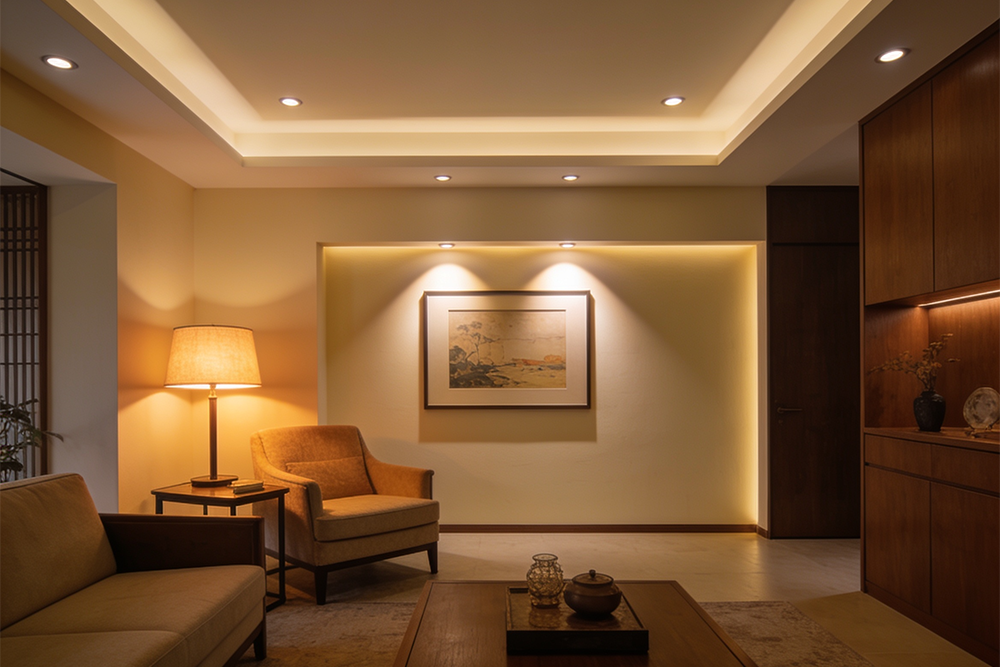
Once you have the right color temperature, three more factors decide whether a room looks designed or just lit. Most homeowners never hear about them, which is why so many do it yourself LED upgrades end up feeling slightly off without an obvious reason. Here are the three that matter most.
CRI Is the Spec Nobody Checks
CRI, the color rendering index, measures how accurately a light source shows colors compared to natural daylight, on a scale up to 100. A cheap LED at 80 CRI lights the room but quietly distorts every color in it. Reds go muddy, blues shift, and skin tones look sallow. A homeowner who chose a warm paint color they love will decide they picked wrong when it looks off under 80 CRI light at night. They did not pick wrong. The light is misrepresenting the color.
We specify a minimum of 90 CRI for living areas and 95 CRI for spaces where color accuracy truly matters, such as a kitchen, a bathroom vanity, or a room with significant art. The price difference over cheap bulbs is small. The difference in how the room looks is not.
Layered Lighting Creates Depth
Most homes are lit entirely with overhead recessed cans, which produces flat light with no depth and casts unflattering shadows on faces. A well designed plan works in three layers at once. Ambient lighting provides the general illumination. Task lighting targets work surfaces, such as under cabinet lights in the kitchen or a properly placed reading light. Accent lighting draws the eye to architecture or art, like a wash on a stone fireplace or a small fixture on a piece of artwork.
When all three layers exist and can be controlled independently, you can shift a room from bright and functional to warm and intimate without changing a single fixture. When only overhead light exists, the only choices are on and off.
Dimmer Compatibility Makes or Breaks It
LEDs dim through a different mechanism than the old incandescent bulbs, and not every dimmer plays nicely with every LED driver. The wrong pairing gives you flickering at low levels, a narrow usable dimming range, an audible buzz, or a cold flash when the switch turns on. The fix is matching the dimmer to the specific fixture it controls and making sure it is loaded correctly, since LEDs draw so little power that a dimmer built for incandescent loads can behave erratically. Quality smart dimmers handle LED loads gracefully and are usually the right call in a home with multiple dimmed zones.
The Fixture Is the Last Decision
The biggest shift in thinking we offer homeowners is that the fixture is almost the last decision, not the first. Before specifying a single bulb, we want to know how each room is used, when it is used, what finishes are in play, and whether you want to shift between functional and atmospheric. Those answers drive the color temperature, the CRI, the placement, and the controls. The fixtures are just how the plan gets delivered. Getting the dimmers and switches right may also mean updating the switches in the room.
Design Lighting That Actually Looks Good
Spectrum Electric plans and installs layered lighting across Apopka, Orlando, Casselberry, and the surrounding cities. Call 407.880.8977 or request a free estimate and we will build a plan around how you actually live in each room.