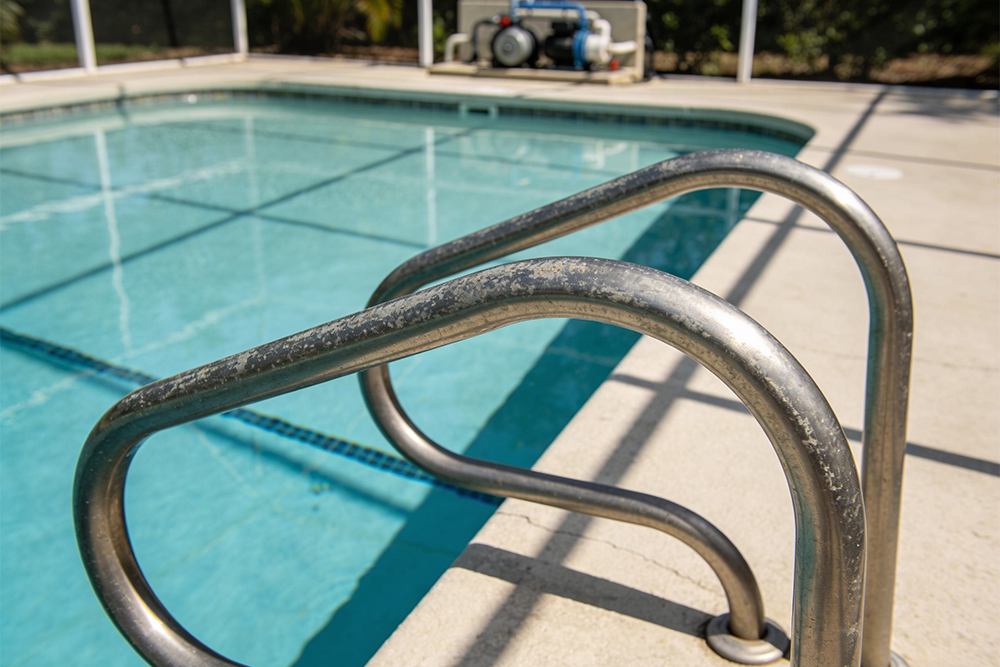
Water and electricity share the same outdoor living space in nearly every Florida home, and that combination is either managed correctly or it is dangerous. There is no comfortable middle ground. The national code dedicates an entire article to pools, spas, and fountains, and Florida adopts and enforces it in full. What separates a safe pool electrical system from a deadly one is not one big thing. It is a series of specific, layered requirements that each exist because someone was seriously hurt when that detail was skipped.
Equipotential Bonding Is the One That Saves Lives
Bonding is the requirement unlicensed installers skip most often, and the consequences of missing it are the most severe. Every metal component within and around a pool must be tied together with a continuous 8 gauge solid copper bonding conductor. That includes the water itself, the pump motor, the light niches, the ladder, the handrails, the deck anchors, the heat exchanger, and any metal within five feet of the water's edge.
The purpose is to eliminate voltage differences between any two things a swimmer might touch at the same time. When bonding is missing or incomplete, a voltage difference can develop in and around the water, and a person becomes the path that equalizes it. This is the mechanism behind electric shock drowning, which kills swimmers in improperly bonded pools and looks, from the outside, like an ordinary drowning. There is no spark and no visible warning. Correct bonding eliminates the hazard entirely.
GFCI Protection Around the Water
Ground fault protection is not optional near a pool, and the code is specific about which circuits need it. Receptacles within 20 feet of the pool, all pool lighting circuits, pump motors, and underwater fixtures all require ground fault protection. Underwater lights must sit in approved housings rated for the job and be positioned well below the normal water line, and any low voltage lighting must be fed by a listed transformer with an isolated winding. Each requirement covers a different failure mode, so skipping one leaves a gap the others do not fill.
Equipment Setbacks That Get Ignored
Panels, disconnects, and outlets serving pool equipment must sit between 5 and 20 feet from the pool's edge, and overhead conductors have their own clearance requirements above and around the water. These distances exist because a pool pole, a toy, or a person in the water can act as a conductor. Crews working fast and without permits tend to put equipment wherever is convenient, and homeowners have no idea the clearances even exist.
Why a Permit and a License Matter Here
All of this work requires permits, inspection, and a licensed electrical contractor in Florida. That is not red tape. It is the mechanism by which an independent party confirms the bonding is continuous, the ground fault protection works, and the setbacks are correct. When an unlicensed crew skips the permit, they also ensure that nobody ever verifies the work is safe. If something later goes wrong around the water, a homeowner's insurance may deny the claim once it learns the work was unpermitted and unlicensed.
Have Your Pool Wiring Verified
If your pool was installed by a crew you are not sure about, or you are adding equipment, have the bonding and ground fault protection verified by a licensed electrician. Spectrum Electric serves Apopka, Orlando, Casselberry, and the surrounding cities and backs every installation with a 1-year workmanship warranty. Call 407.880.8977 or request an inspection.