Central Florida sees some of the highest lightning activity in the country, and that puts every home in the Orlando area at real risk every storm season. Most homeowners think the power strip behind the television is protecting their electronics. The honest truth is that it protects very little. Understanding the difference between a plug in surge strip and whole home surge protection is one of the most valuable things a homeowner can learn before the next storm rolls through.
What a Plug In Surge Strip Actually Does
Plug in surge strips are the power strips you find at the big box store with a surge protection label. They typically handle somewhere between 200 and 1,000 joules of surge energy. That sounds like a lot until you consider that a lightning strike can dump roughly a billion joules into the utility feed. A plug in strip only protects what is plugged into it, and only from a surge traveling through that one circuit.
There are two more problems most people never hear about. The protective components inside the strip wear out silently as they absorb small hits, yet the green protected light usually stays on even after the part inside is spent. You think you are covered when you are not. And a plug in strip does nothing for a surge that enters through your coax cable, your phone line, or your main panel and then travels through the entire house at once. Think of a plug in strip as a last line of defense, not a strategy.
How Whole Home Surge Protection Works
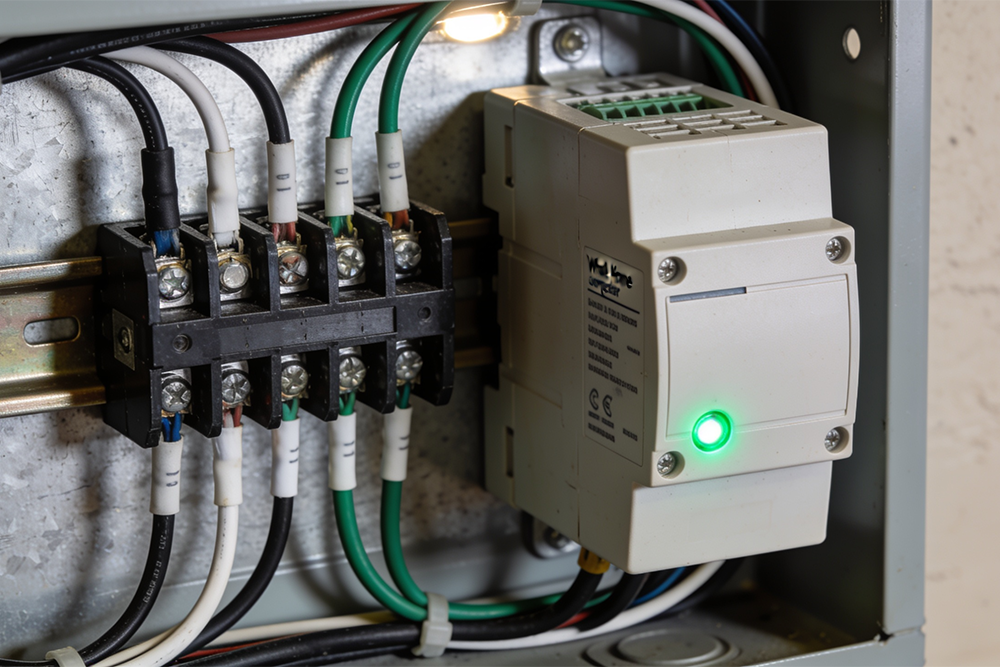
A whole home surge protective device installs at or just ahead of your main panel and works on a completely different level. It clamps voltage spikes at the source, before they branch out to every circuit in the house. Quality residential units are rated for tens of thousands of amps of surge current and protect every circuit at the same time, from your outlets and hardwired appliances to your air conditioning system, well pump, and EV charger.
There are two common types. A device installed before the main breaker can handle higher energy and is typically paired with a lightning rod system. The more common residential choice mounts inside or right next to the main panel, after the main breaker, and handles the bulk of a surge for the whole home. Better units include an indicator light or an audible alarm that tells you when the device has taken a hit and needs replacement, so you actually know your protection is intact.
The Smart Approach Is Layered Protection
The strongest setup combines a whole home device at the panel with quality point of use strips at sensitive electronics. The panel device absorbs the large surge, and the strip catches the small amount of residual energy that gets through. One supports the other. If you also rely on a whole home generator during outages, surge protection becomes even more important, since sensitive generator controls and transfer equipment deserve the same defense as the rest of the home.
What We See in Orlando Area Homes Without Protection
After a storm, the same victims show up again and again. Air conditioning control boards are extremely vulnerable, and a single nearby strike can take out a board on an otherwise healthy system. Refrigerators, smart televisions, routers, and mesh WiFi systems get wiped out regularly, often through the coax line rather than the outlet. Variable speed pool pump controllers and well pump boards are frequent casualties too.
The most dangerous damage is the kind you cannot see. A surge can arc inside your walls and score the insulation on your wiring. The breaker does not trip, the outlet still works, but you now have compromised wiring that can become a fire hazard months later under load. A strike does not even have to hit your house. A strike to a utility pole a quarter mile away travels the line and reaches every home on that circuit.
Protect Your Home Before the Next Storm
A whole home surge protective device at the panel is one of the highest value protection investments a Central Florida homeowner can make. Spectrum Electric installs them as a licensed Florida electrical contractor, and we back our work with a 1-year workmanship warranty. Call us at 407.880.8977 or request a free estimate to protect your home in Apopka, Orlando, Casselberry, and the surrounding cities.