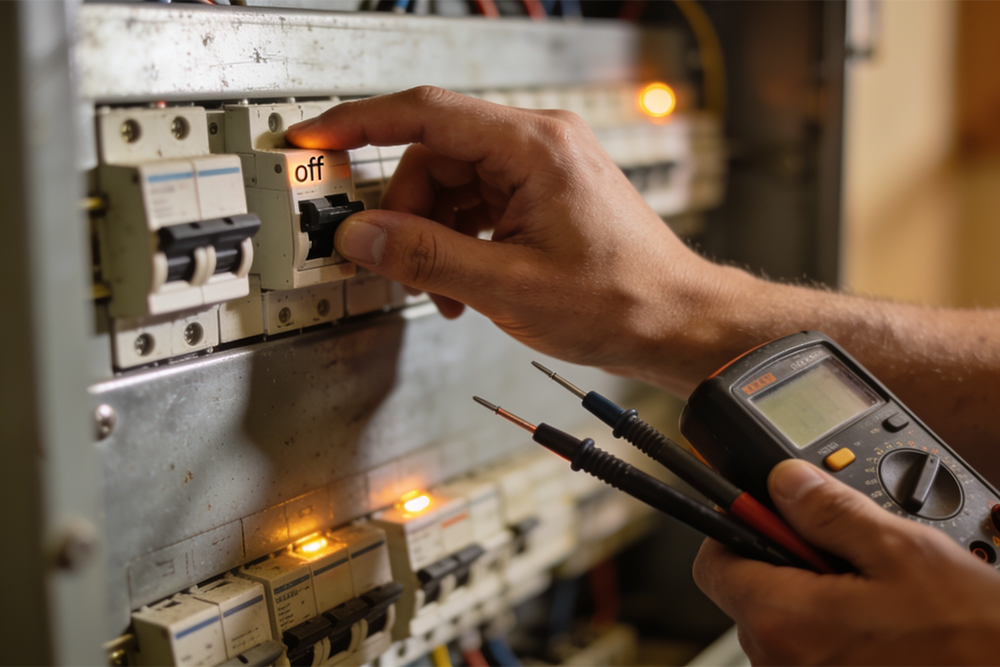
A breaker trips to protect your wiring from overheating, so a single trip after plugging in too much at once is the system doing its job. The problem is the breaker that trips again and again. The thing that separates a trained electrician from a handyman on this call is understanding that the symptom and the cause are almost never in the same place. Resetting the breaker treats the alarm, not the fire.
The Diagnosis Starts With Questions
Before we touch a single device, we ask a specific set of questions, because the answers narrow the search dramatically. When does it trip, and at what time of day or season? Does it happen when something specific turns on, or at random? Has anything changed recently, like a new appliance, a renovation, or a recent storm? Is it always the same breaker, or does it move? A breaker that trips every evening tells a different story than one that trips at two in the morning with nothing running.
Reading the Panel, Not Just the Breaker
At the panel we are not only looking at which breaker tripped. We check for heat discoloration on the bus bar, breakers that feel warm compared to their neighbors, signs of arcing, double tapped terminals, and wire gauges that do not match their breaker rating. A breaker that resets easily and holds behaves very differently than one that is hard to reset or trips again quickly, and that difference points us toward the breaker, the load, or a fault in the wiring.
Load Isolation
Rather than guessing, we systematically reduce the load on the circuit. We unplug everything and watch it under no load. If the breaker holds with nothing running, the problem is likely an overloaded circuit carrying more than it was designed for. If it trips even with nothing plugged in, we know there is a wiring fault, a failing breaker, or a ground fault, which is a completely different investigation. That one step rules out half the possibilities before we open an outlet.
Thermal Imaging Finds the Hidden Hot Spot
A connection that looks fine, tests fine, and has not tripped anything yet will still show up as a hot spot on a thermal scan, because resistance generates heat in proportion to the current flowing through it. Running a thermal camera across outlets, switch plates, the panel face, and accessible attic wiring reveals connections that are developing resistance long before they fail. This is how we find a loose neutral or a corroded junction buried in the attic that has been quietly arcing for months. The repair is often quick once the spot is found.
When the Panel Itself Is the Problem
Sometimes the honest answer is that an undersized or aging panel is being asked to carry loads it was never designed for, which is common in older Central Florida homes. In that case the fix is a panel upgrade rather than chasing one circuit at a time. We tell you plainly when that is the case and when it is not.
Stop Resetting and Get an Answer
If you are resetting the same breaker every week, have it diagnosed before it becomes a bigger problem. Spectrum Electric provides honest troubleshooting, inspection, and 24 hour emergency service across Apopka, Orlando, Casselberry, and the surrounding cities. Call 407.880.8977 or request a visit.