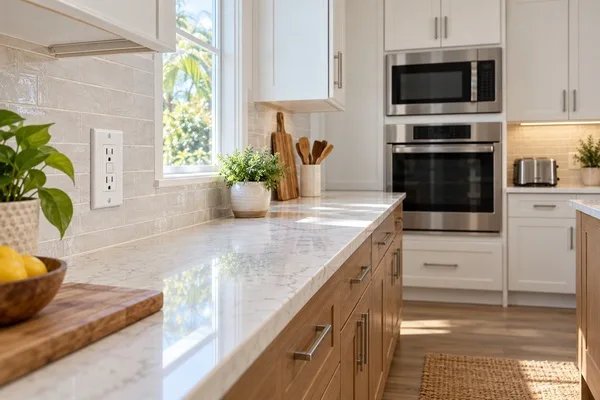
A kitchen remodel almost always needs new electrical work: dedicated circuits for major appliances, code-compliant countertop outlets with GFCI protection, and sometimes more panel capacity. A licensed electrical worker handles that work with permits and inspections, so your new kitchen is safe, passes inspection, and does not cause problems when you sell.
At Spectrum Electric Inc., we are a Florida State Certified Electrical Contractor based next door in Casselberry. Before your remodel starts, reach out to our team or call (407) 880-8977 for an estimate.
Why does a kitchen remodel need a licensed electrical worker?
Because kitchen wiring has some of the strictest code requirements in the house, and mistakes there carry real risk. Kitchens combine water, heat, and high-power appliances, often on the same wall.
Many Winter Springs homes, from Tuscawilla to the neighborhoods off State Road 434, were built decades ago. Their kitchens were wired for the appliances of that era, not for a modern induction cooktop, a built-in microwave, and a counter full of small appliances.
Florida electrical work is governed by the Florida Building Code and the National Electrical Code. Those are minimum safety standards, built from decades of data on electrical accidents. Meeting them takes training, the right materials, and the experience to know how they apply to your layout.
A licensed pro also pulls the permit and coordinates the inspection. That protects you now and later. Unpermitted electrical work can come up during a home sale inspection, delay closing, or cost you money to correct.
Which kitchen appliances need their own dedicated circuits?
Large or high-draw appliances usually need a circuit of their own, so they do not overload a shared line or trip breakers when several things run at once.
Cooking appliances are the big ones. Electric ranges, wall ovens, and induction cooktops typically run on a dedicated 240-volt circuit sized to the appliance. Dishwashers, garbage disposals, built-in microwaves, and refrigerators are also commonly placed on their own circuits, depending on the appliance and local code.
Countertop outlets need their own circuits too. Code requires at least two 20-amp small appliance circuits for kitchen counter outlets, which keeps a coffee maker, toaster, and mixer from overloading a single line.
A customer remodeling her kitchen was proud of her new induction cooktop and could not wait to make her famous chili. She wanted it to go right where the old stove had been. We reviewed the setup and the electrical requirements for the new cooktop, so the circuit would match what the appliance actually needs.
How do countertop outlet spacing and GFCI rules work?
Countertop outlets must be close enough together that you never need an extension cord. Under the National Electrical Code, outlets are generally placed so that no point along the counter wall is more than 2 feet from one.
That usually means an outlet at least every 4 feet along the backsplash, plus outlets on shorter counter sections. Islands and peninsulas have their own requirements, which have changed in recent code updates, so they are worth reviewing during design.
GFCI protection is required for any outlet serving countertop surfaces. GFCI outlets cut power instantly when they sense a ground fault, which matters in a room where hands, sinks, and appliances are always close together. We call them a life-saving device, plain and simple.
We also install tamper-resistant receptacles and high-powered USB-A and USB-C outlets that charge devices faster and free up standard plugs. Learn more about our outlet and switch installation.
Will your panel need more capacity first?
Often, yes. Adding new dedicated circuits for an induction cooktop, a second oven, or other appliances can push an older panel past what it can safely handle.
Warning signs include breakers that trip often, kitchen lights that dim when the AC starts, warmth or discoloration at the panel, or a home over 30 years old still running on its original panel. Older 100-amp panels were not engineered for the demands of a modern Florida kitchen.
If your service has enough amperage but not enough breaker space, a subpanel may solve it. If you need more capacity, an upgrade to 200-amp service is the modern standard. Most panel upgrades take about one day, roughly 4 to 8 hours, though utility coordination can extend that.
Planning this early keeps your remodel on schedule. You do not want cabinets installed and counters set before discovering the panel cannot support the new appliances. See our panel upgrades.
How do you keep the electrical work on schedule during a remodel?
Bring your electrician in before demolition starts. The electrical plan should be settled while walls are open and before cabinets, backsplash, and counters go in.
Share your appliance list and model numbers early. Each appliance has specific circuit requirements, and knowing them up front avoids rewiring after the fact. Coordinate with your contractor so rough-in happens at the right stage, and so the inspection is done before walls are closed.
We handle permitting and coordinate the final inspection with the local building department. We give free estimates with transparent, upfront pricing, and no hidden fees. That makes it easier to fit the electrical work into your overall remodel budget from day one.
Planning a kitchen remodel in Winter Springs? Contact Spectrum Electric Inc. or call (407) 880-8977 to request an estimate from a licensed electrical worker before your project begins.