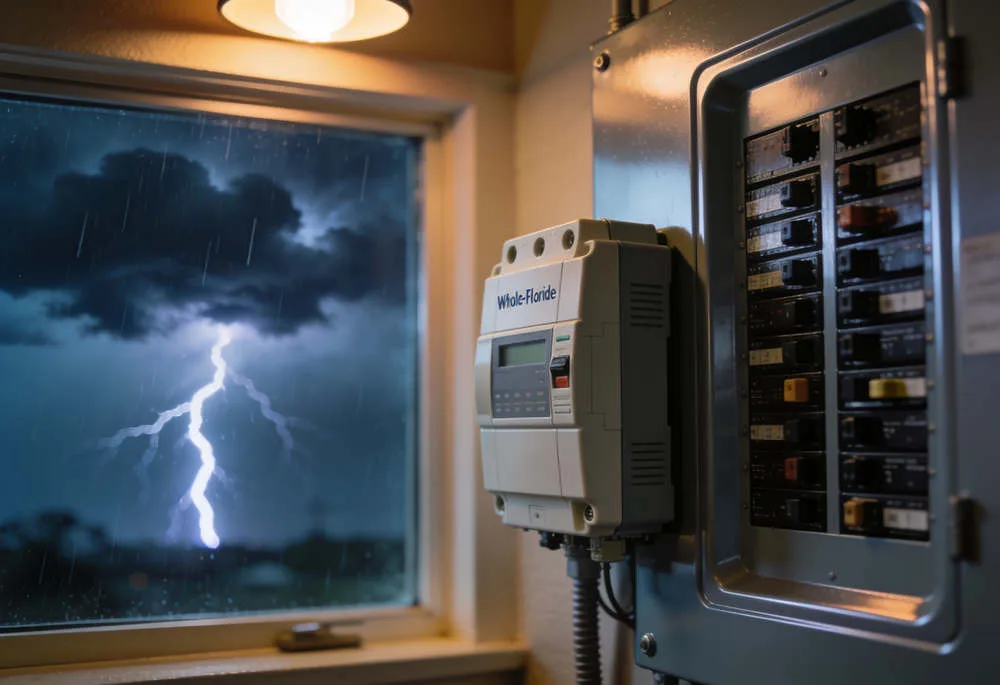
Florida leads the country in lightning strikes, and Central Florida sits in the middle of the most active zone. Every afternoon thunderstorm that rolls through Apopka between June and October brings the potential for a voltage spike on the utility line serving your home. Most of the time nothing happens. Occasionally a surge rides that line in and finds every piece of electronics and appliance connected to your circuits. A whole-home surge protection device installed at the panel is a small piece of hardware standing in front of a lot of expensive equipment. Spectrum Electric Inc. installs panel-level surge protection for homeowners across the Apopka and Orlando area as a standalone service or alongside any other electrical visit. Contact Spectrum Electric Inc. to schedule an install or call (407) 880-8977 and add it to your next electrical appointment.
Where surges actually come from
Homeowners in the Apopka area often assume surge damage only comes from a direct lightning strike. It does not. The more common path is a nearby strike on the utility infrastructure, a transformer, a power line, or the ground near a line, that sends a voltage spike through the grid before it reaches the meter on your house. The surge travels in along the service entrance, through your panel, and out to every circuit in the home in the same instant. A direct strike to a nearby tree or the street outside your house can do the same thing without touching your structure at all. There is no warning, no flicker before it happens, and no time to unplug anything.
In the Altamonte Springs corridor north of Orlando, where afternoon storms build quickly over the lake-heavy terrain, this kind of event is routine enough that most homeowners in the area have experienced at least one unexplained electronics failure after a storm. Sometimes it is a dead modem. Sometimes it is a television that simply stopped working the morning after a heavy lightning night. The connection to the surge is not always obvious because the equipment often fails gradually over days or weeks rather than all at once. A surge does not have to destroy a device immediately to have damaged it.
Homes in the Conway area of southeast Orlando carry the same exposure as anywhere else in Orange County, but the concentration of mature trees and older utility infrastructure in established residential neighborhoods can amplify the risk. Trees that fall on lines during storms create additional surge events beyond what the lightning itself produces. Any event that interrupts and restores power on the grid, whether from a storm, equipment failure, or utility switching, generates a transient voltage spike that travels along the line.
What a whole-home surge device actually does
A panel-level surge protection device is a relatively compact unit that mounts inside or adjacent to the electrical panel and monitors the incoming voltage continuously. When it detects a spike above the normal operating threshold, it clamps the voltage and diverts the excess energy to ground before it reaches the branch circuits in the house. The response time is measured in nanoseconds. The device absorbs the spike so the circuits downstream do not have to.
The protection covers everything connected to the home's electrical system: televisions, computers, smart-home devices, the control boards inside the HVAC system, the electronics in modern refrigerators and dishwashers, and any other appliance that contains a circuit board. The HVAC control board is one of the more expensive single-component failures that follows a surge event, and it is also one of the least obvious because the unit may appear to run normally before the board fails completely weeks later.
Individual power strips with built-in surge suppressors offer limited point-of-use protection. They are not equivalent to a panel-level device. A strip suppressor rated for a few hundred joules protects what is plugged into it and nothing else. A whole-home device at the panel protects the entire system from the point of entry.
When to install it and what it pairs with
Surge protection installation is one of the faster electrical jobs on the list, which makes it easy to add to any existing appointment rather than scheduling a separate visit. Homeowners who are already planning a panel upgrade are in the natural moment to add it, since the panel will already be open and the work can be done in the same visit. It also pairs naturally with any inspection or Residential Electrical Services call where an electrician is already on-site.
For homes that have not had any recent electrical work done, a surge device installation is a standalone service that does not require a panel upgrade or other work as a prerequisite. The installation is straightforward, the device carries its own manufacturer warranty alongside our 1-year workmanship warranty on the install, and the written price is the price before the work begins. Spectrum is Florida State Certified (license EC13008455) and fully insured.
If your home is in Central Florida and does not have panel-level surge protection, summer is the season that makes the gap visible. Call Spectrum Electric Inc. at (407) 880-8977 or schedule your surge protection installation with Spectrum Electric Inc. before the next storm season makes the case for you.