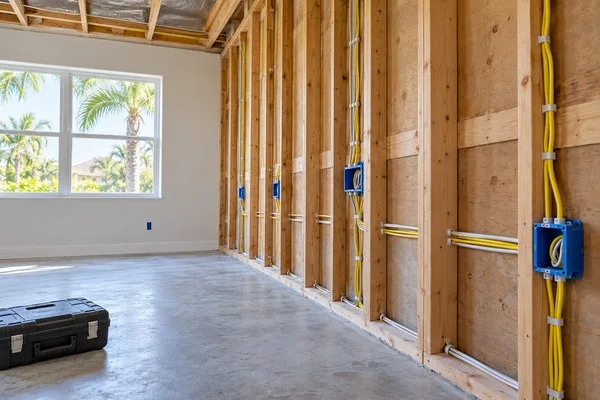
The right electrical contractor plans your addition's wiring before the first wall goes up. That means mapping new circuits, deciding whether you need a subpanel, sizing for HVAC and outlet loads, and confirming your main panel can carry the extra demand, then pulling permits and working on the general contractor's schedule so inspections pass the first time.
At Spectrum Electric Inc., we are a Florida State Certified Electrical Contractor working in Longwood homes every week. To plan your project, reach out to our team or call (407) 880-8977.
What does an electrical contractor plan for a home addition or garage conversion?
An electrical contractor plans everything the new space will need to be safe and comfortable: lighting, outlets, heating and cooling, and any special equipment, along with how all of it connects back to your panel.
Garage conversions are a good example. Most garages were wired for a door opener, a few lights, and some outlets. Turning one into a bedroom, office, or family suite means bringing it up to the standards of living space, with proper outlet spacing, lighting, smoke alarm requirements, and protection devices that garages often lack.
Longwood's housing mix matters here. Homes in the Historic Longwood District, Sweetwater Oaks, or Sabal Point may have older wiring or panels that were never meant to support more square footage. Some homes built between 1965 and 1973 have aluminum wiring that needs special attention when new circuits tie in.
A good plan accounts for all of it up front, so you are not making expensive changes after drywall goes up.
How are new circuits, subpanels, and HVAC loads sized?
They are sized from a load calculation, which adds up everything the new space will use and checks it against what your electrical service can supply.
HVAC is usually the biggest piece. Many additions and garage conversions use a ductless mini-split or an extension of the existing system, and either one needs a properly sized circuit. Outlets, lighting, ceiling fans, and any appliances, like a mini fridge or a home office setup, all get counted too.
From there, your contractor decides how to feed the space. Some additions can run new circuits straight from the main panel. Others work better with a subpanel in or near the addition, especially when the main panel has enough amperage but not enough breaker space.
Thinking ahead helps. If you might add an EV charger, a hot tub, or a workshop later, it is often easier and cheaper to plan for that capacity now.
Can your main panel support the addition?
Sometimes yes, sometimes no. It depends on your panel's capacity, its condition, and how much load the addition adds.
Many older Longwood homes still run on 100-amp panels, which were not engineered for the demands of a modern Florida household plus a new room. Some still have Zinsco or Federal Pacific Stab-Lok panels, whose breakers are documented to fail during an overcurrent event. Adding load to one of those is not a safe plan.
If your panel is undersized or outdated, an upgrade to 200-amp service is the modern standard, and larger homes with heavy loads may need more. Most panel upgrades take about one day, though utility coordination at the meter can add time. Your contractor should check this before the addition's schedule is set.
Doing the upgrade as part of the addition keeps everything under one permit and one schedule. Learn more about our panel upgrades.
Why do permits, inspections, and coordination matter so much?
Because electrical work on an addition is inspected in stages, and missing a step can stall the whole project. Rough-in wiring has to be inspected before insulation and drywall, then the final inspection comes once everything is installed.
Coordination with your general contractor keeps those steps on time. The electrician needs to rough in after framing and before walls close, and any changes need to happen while they are still easy to make.
One of our customers was converting his garage into a room for his mother. We had a plan in place, but then his mom mentioned she wanted a particular reading lamp next to her reading chair.
Before the walls closed, we reviewed the electrical plan to make sure we could make it happen. That kind of small, personal detail is exactly why the electrical plan should stay flexible until rough-in inspection. We never work without the proper Seminole County permits.
What should you ask before hiring an electrical contractor?
Ask questions that show how the contractor will plan, price, and protect your project. Good answers should be clear and specific.
Start with credentials. What is your license number, and can I verify it with the Florida DBPR? Can you send a current certificate of insurance directly to me? Then ask about the plan. Will you do a load calculation? Do I need a panel upgrade or a subpanel? Who pulls the permit and schedules inspections?
Finally, ask about price and protection. Is the price fixed and in writing? How are changes handled? What warranty comes with the work?
At Spectrum Electric, we provide free estimates with an upfront, fixed price in a written proposal before any work begins, and our work comes with a one-year warranty. Learn more about our work as an electrician in Longwood, FL, then contact Spectrum Electric Inc. or call (407) 880-8977 to get a scoped estimate for your addition.