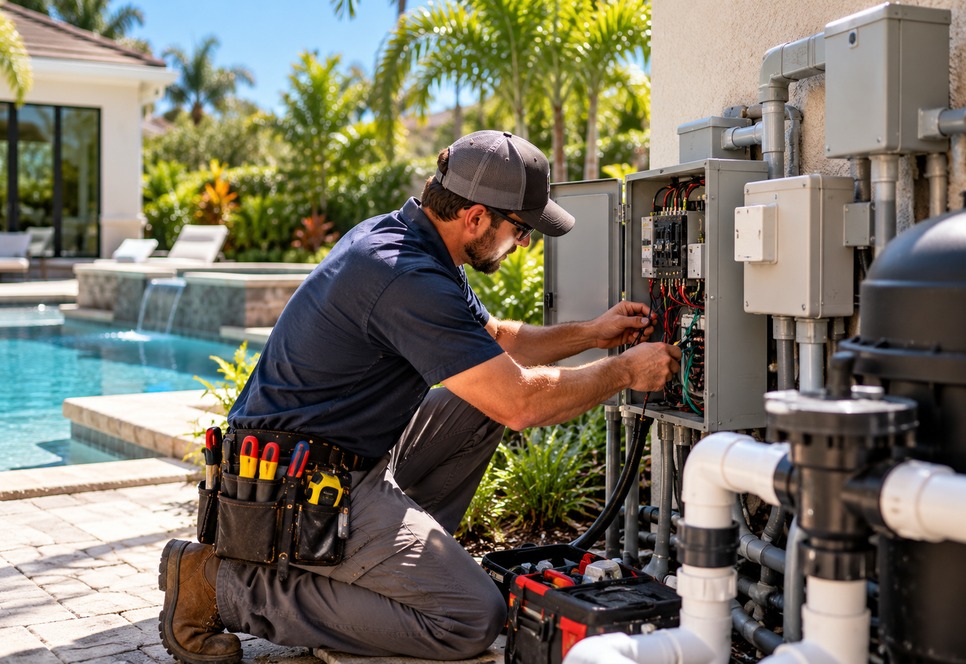
A new hot tub or a pool pump upgrade is a great addition to an Oviedo backyard. The wiring behind it is another story. You are putting 240 volts a few feet from hundreds of gallons of water, and the code section covering pools and spas (NEC Article 680) is among the strictest in the book. This is a job for a licensed electrical worker who pulls the permit and stands behind the inspection. At Spectrum Electric Inc., we treat every spa and pool equipment job as a safety job first. Before your tub is delivered, reach out to our team at (407) 880-8977 and we will tell you what your panel and your yard actually need.
What electrical work does a new hot tub need?
Most full size hot tubs need their own dedicated 240 volt circuit, usually in the 40 to 60 amp range depending on the heater and pumps, run from your main panel to a GFCI protected disconnect near the tub. Even smaller 120 volt plug in models need a dedicated GFCI circuit.
The first thing we check is not the backyard. It is the panel. In established neighborhoods like Alafaya Woods, we regularly open panels already carrying a pool pump, an electric range, a dryer, a water heater, and the air conditioning. Adding a spa breaker without a load calculation is how breakers start tripping on hot August nights, or worse, how a connection quietly runs hot inside the panel. Sometimes there is room. Sometimes you need a subpanel or a service upgrade, and you want to know before the tub is on its pad. Working that out is part of the residential electrical services we provide.
Why does GFCI protection matter so much near water?
A GFCI cuts power in a fraction of a second when it senses current leaking where it should not, like through water or through a person. Near a pool or spa, that fraction of a second is the whole point.
Code requires GFCI protection on hot tub circuits, on pool pump motor circuits, and on receptacles within a set distance of the water. In communities like Live Oak Reserve, screened pool cages often put the equipment pad, a hose bib, and an old exterior outlet in the same narrow side yard. An unprotected outlet in that spot is a real hazard, and a previous owner's quick fix is often the first thing we find. When a GFCI keeps tripping after a summer storm, the fix is finding the wet junction box or failing heater element. It is never swapping in a standard breaker, because that removes the one device standing between a fault and whoever is in the water.
How do you size the disconnect and wiring for a spa or pool pump?
You size them from the equipment nameplate and the manufacturer's instructions, then adjust for distance and conditions. The disconnect has to be within sight of the tub and at least five feet from its inside wall, so someone can kill the power without reaching over the water.
Distance is where homeowners get surprised. On the bigger lots out toward Black Hammock, a tub or equipment pad can sit a long way from the panel, and a long run needs heavier copper to keep voltage drop in check. Undersized wire rarely fails on day one. It runs warm. The heater struggles, the pump motor wears out early, and a warranty claim gets denied because the install did not match the spec sheet. We also check the route: conduit buried at the right depth, wire rated for wet locations, and an insulated copper grounding conductor. None of it is visible once the trench is filled, which is exactly why it has to be right the first time.
What does bonding and grounding pool equipment actually do?
Grounding gives fault current a safe path back to the panel so the breaker trips. Bonding ties the metal around the water together so it all sits at the same voltage, leaving nothing for your body to bridge.
For a pool, that bonding grid is typically solid copper wire connecting the pump motor, the heater, ladder and rail anchors, the steel in the pool shell, and the water itself. Hot tubs have their own rules for nearby metal like railings, fence sections, and door frames. Skip it and everything can look fine for years. Then a failing pump motor puts a few volts on a handrail, and someone in the pool feels a tingle, or something much worse. That is why, whenever we replace pool equipment in Oviedo, we check the bond wire at the pad before anything else. On older installs we often find it cut, corroded, or never reconnected after the last pump swap.
Does a licensed electrical worker have to permit and inspect the job in Oviedo?
Yes. Hot tub and pool equipment wiring needs an electrical permit and a passed inspection, whether you live inside city limits, where permits go through the City of Oviedo Building Services office on Alexandria Boulevard, or in unincorporated Seminole County. You may have heard about Florida's new $7,500 permit exemption that took effect July 1, 2026. It does not cover electrical work at any price.
The inspection is your independent proof that the circuit, GFCI, disconnect, and bonding were done right, and insurers and future buyers care about it. We pull the permit and meet the inspector. Our electrical inspections service can also review a pool or spa setup you inherited with the house.
One recent customer asked us for an estimate on wiring his new hot tub and admitted he was thinking his friend might wire this puppy for some pizza and beer. The friend is great at DIY, he told us. We walked him through the dedicated circuit, the GFCI protection, the bonding, and the inspection requirements. By the end of that conversation, he had decided that 400 gallons of water next to electricity is a job for a professional.
If you are adding a hot tub or upgrading pool equipment in Oviedo, let a licensed electrical worker handle the part that touches the water. Call Spectrum Electric Inc. at (407) 880-8977 or send us a message to get your project permitted, wired, and signed off.