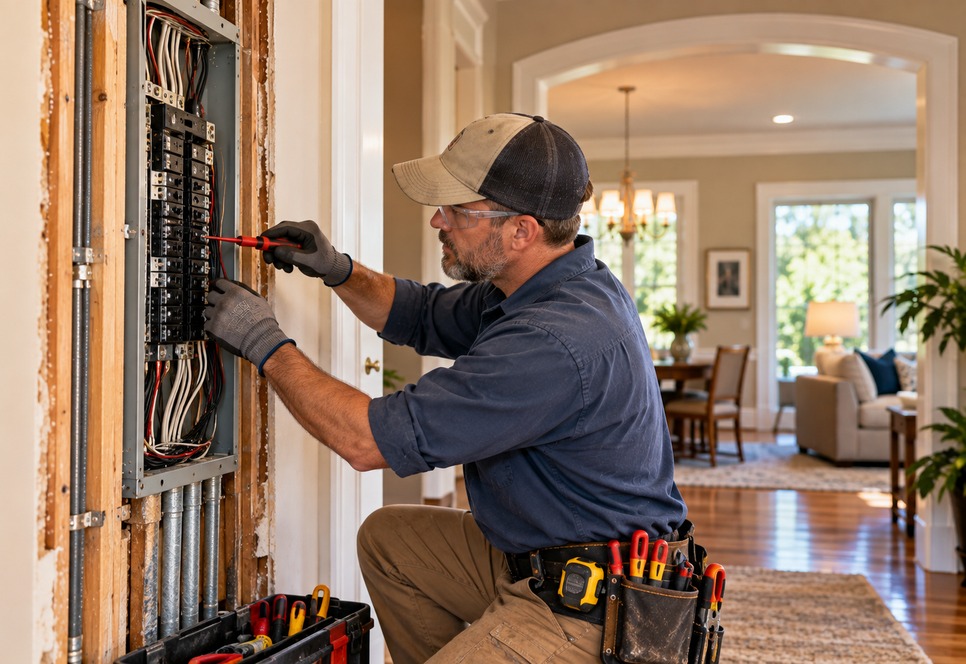
Most older homes send warning signs long before the wiring actually fails. A light that flickers, an outlet that feels warm, a breaker that trips every time the space heater comes on. Some of those point to simple electrical repairs. Others mean the wiring behind your walls is near the end of its life. The trick is telling which is which before a small problem becomes a burned connection. At Spectrum Electric Inc., we open up older walls in Lake Mary all the time, and we can usually tell you in one visit what you are dealing with. If you are seeing any of the signs below, schedule a diagnostic visit by calling (407) 880-8977.
Are flickering lights and warm outlets a sign you need rewiring?
Sometimes. One flickering fixture is usually a loose bulb, a worn switch, or a failing connection that a repair can fix. Flickering across several rooms, or any outlet or switch plate that feels warm to the touch, points to a wiring problem that needs a closer look.
Heat is the sign we take most seriously. A warm cover plate means resistance somewhere in that connection, and resistance means heat building inside a box you cannot see. In the older homes on the streets around Crystal Lake, we often trace that heat back to backstabbed receptacles (wires pushed into holes in the back of the outlet instead of wrapped around the screws) or connections that have loosened over decades of heating and cooling. Look for faint brown marks around the slots, a smell like hot plastic, or a plug that falls out of the outlet on its own. Any of those deserves a call the same week. Tracking down the source is routine residential electrical services work, and on many homes the fix stops right there. On others, the same damage shows up in box after box, and that pattern tells us something bigger is going on.
Does an older home have enough grounded outlets for today's loads?
Often it does not. Homes built decades ago were wired for a refrigerator, a few lamps, and maybe a window unit, not home offices, big TVs, air fryers, and an EV charger in the garage.
Two problems show up together. First, too few circuits, so the kitchen and a bedroom share one breaker that trips whenever the microwave and a hair dryer run at once. Second, two prong outlets with no ground wire behind them. Swapping in a three prong receptacle without a ground does not make the outlet safer. It just hides the problem from you and from the surge protector plugged into it. Around the older part of town near the Lake Mary SunRail station, we still find houses where extension cords and power strips are quietly doing the job the wiring should be doing. The panel is often part of the story too. An older or undersized panel with no open spaces limits what we can add, and some brands have a known history of breakers that fail to trip. When that is the case, panel upgrades usually come before any new circuits go in.
What does cloth or crumbling wire insulation mean for your home?
It means the wiring has aged past the point where repairs make sense in that area. Cloth sheathed cable and early rubber insulation turn brittle over time, and once it cracks, bare copper can touch the box, a staple, or the wood framing.
You can sometimes spot it yourself. Pull a cover plate off with the power off and look at the wire where it enters the box. Fabric wrapping, rubber that flakes when touched, or wires with no bare ground conductor are all signs of an older system. In attics, the Florida heat speeds the process up, and we have pulled cable out of homes near Lake Emma where the insulation crumbled into our hands. Some homes from the late 1960s and early 1970s also have aluminum branch wiring, which needs specific connectors and a careful inspection. None of this means your house is about to catch fire tomorrow. It does mean that every time someone opens one of those boxes to replace a fixture, the old insulation can break further, which is why patching it room by room rarely holds up.
How does an electrician decide between electrical repairs and a full rewire?
We test before we recommend. A proper diagnostic visit looks at the panel, measures circuit loads, opens a sample of boxes in different rooms, and checks for grounding, heat damage, and insulation condition, so the answer is based on what is behind the walls and not a guess.
The result is often a mix. Some circuits are sound and only need targeted electrical repairs. Others need to be replaced, and a partial rewire of those sections can cost far less than redoing the whole house. A recent Lake Mary family had started calling one part of their home the haunted hallway, because two fixtures there would flicker on their own. The flickering was what got them to call us, but it was the warm outlets elsewhere in the house that told us the old wiring might need to be reworked. Our inspection let us separate the circuits that could be repaired from the places that genuinely needed rewiring, so they paid for what the house actually needed and nothing more.
If your Lake Mary home is flickering, running warm, or running out of outlets, do not wait for the problem to decide for you. Call Spectrum Electric Inc. at (407) 880-8977 or book your diagnostic visit online, and we will tell you plainly whether you need repairs or a rewire.