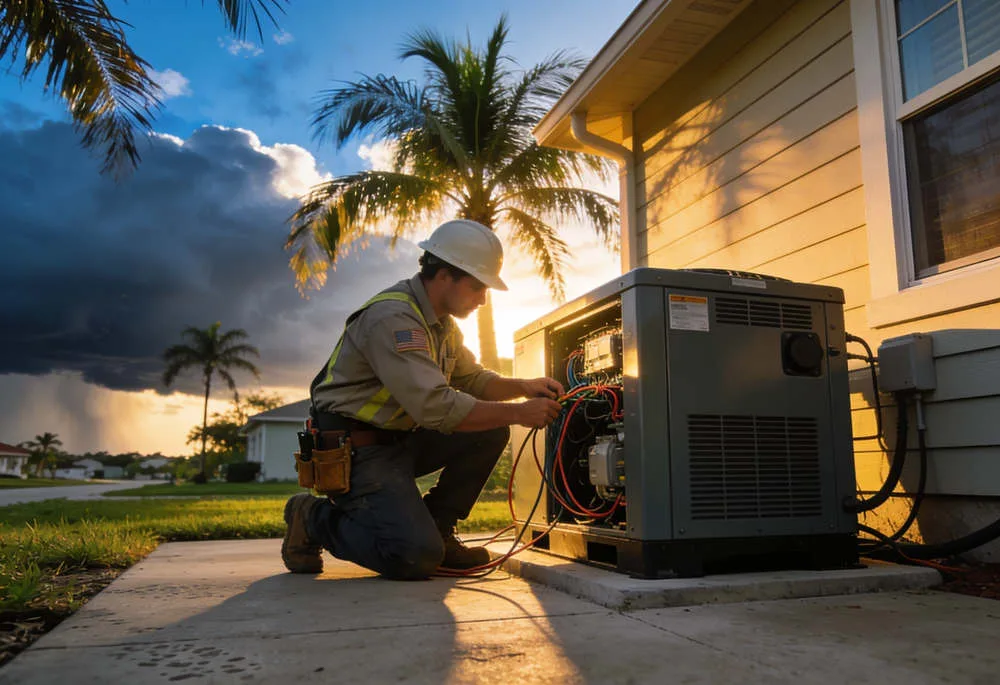
For most Central Florida homeowners, a whole-home standby generator stopped being a luxury item a few hurricane seasons ago. Extended outages after tropical weather events have become common enough that the question is less "do I need one" and more "what does a properly installed system actually involve." The short answer: a standby generator wired correctly with a transfer switch keeps your essentials running when the grid drops, and it does it automatically, without anyone going outside in the middle of a storm to pull a cord. Spectrum Electric Inc. handles generator installations across the Orlando and Apopka area, including the permits that Orange and Seminole counties require. Schedule a free assessment with Spectrum Electric Inc. or call (407) 880-8977 before the storm-season rush starts.
Standby versus portable: the difference that matters
Homeowners in the Windermere area who went through multi-day outages after recent storms have tried both options, and the feedback on portable generators is consistent: they work, but they require more from you than most people expect at 2 a.m. in August. A portable unit needs to be stored, retrieved, fueled, started, and extended to the house through a cord or a transfer switch you have to manually engage. If it is not already wired into a proper transfer switch, using it incorrectly can backfire feed electricity into a line that crews assume is dead, which is a danger to workers and to the generator itself. The convenience gap between portable and standby is real.
A permanently installed standby generator in communities like Oviedo and throughout Seminole County operates differently. It sits on a concrete pad outside the house, connects to the natural gas or propane line, and monitors the grid continuously. When power goes out, it starts automatically and switches the house over within seconds. When grid power returns, it switches back and shuts itself down. The homeowner does not have to do anything. The system runs a self-test weekly, so by the time a storm arrives, the unit has already confirmed it is ready. For households with medical equipment, insulin storage, or residents who cannot be without air conditioning in Florida heat, that automatic response is not a convenience feature. It is a safety requirement.
The Lake Mary and Sanford corridor in Seminole County tends to see some of the longer restoration timelines after major storm events because of the mix of older infrastructure and newer residential development in the same service area. Homeowners who have been through a week-long outage in that kind of heat tend not to need much convincing that a standby system was worth the investment. The ones who are still deciding usually get there after the second or third event.
Why transfer switch wiring is the part that cannot be skipped
A generator without a properly installed transfer switch is either inconvenient or dangerous, depending on how it is connected to the home. The transfer switch isolates the home's electrical system from the utility grid when the generator is running. Without it, a generator powering the house is also potentially sending electricity back into the utility lines. That backfeed is how lineworkers are injured during restoration work. Orange and Seminole counties both require a permit and inspection for generator installations precisely because the transfer switch wiring is a safety-critical element that needs to be done correctly and verified by an inspector before the system is considered complete.
Spectrum pulls the permit, schedules the inspection, and does not consider the job done until the county signs off. That is the correct sequence, and it is also what protects the homeowner if anything related to the installation is ever questioned by an insurer or a future buyer.
What a whole-home system costs in general terms
Whole home generators vary in price based on the generator's kilowatt output, the fuel source, and the complexity of the installation. A system sized for the essentials, meaning HVAC, refrigeration, lighting, and critical outlets, typically costs less than a whole-house system that runs every circuit simultaneously. Most residential generator installations fall in a range that reflects those variables, and Spectrum's written estimate covers the full scope before any work begins. The written price is the price. No additions at the end because the assessment was not thorough at the start.
Spectrum is Florida State Certified (license EC13008455), fully insured, and generator installations carry the same 1-year workmanship warranty as all of Spectrum's Residential Electrical Services. The assessment visit is the right first step because it identifies the correct generator size for the home, confirms the fuel connection and pad location, and produces a fixed written quote with no estimates that change after the equipment arrives.
Why scheduling before storm season matters
Generator demand in Central Florida follows a predictable pattern: it spikes sharply when a named storm enters the Gulf, and every licensed electrician in the market is booked out within days. Homeowners who call in August looking for an installation before a storm that is already on the forecast usually cannot get one. The lead time on equipment and the scheduling backlog both extend significantly during active storm periods. The homeowners who have a generator installed and running before June 1 are the ones who made the call in February or March, when the schedule was open and the equipment was available without a wait.
If a whole-home standby system is something you have been thinking about, now is the right time to find out what the installation actually involves for your specific home. Call Spectrum Electric Inc. at or request your free generator assessment from Spectrum Electric Inc. before the season makes the schedule unavailable.