
Multifamily New Construction Electrical at Hawthorne Heights
A five story apartment community wired from the footing trenches up, with temporary power feeding every other trade on the way.
A five story apartment community wired from the footing trenches up, with temporary power feeding every other trade on the way.

Hawthorne Heights went up the way most Central Florida apartment communities do. Block for the lower floors, wood frame above, scaffold across the face for months, and a laydown yard that kept moving as the building grew.
Electrical on a job like this is not one scope, it is a sequence. It starts in the dirt before there is a building, with rebar being tied in the footing trenches and conduit stubs standing out of the fill. Then the duct bank. Then temporary power, which every other trade on the site depends on. Then the rough in, unit by unit and box by box, once the framers have finally given us walls to nail to. Each stage has an inspection gate and each one blocks the next. Multifamily sits between our commercial electrical side and our residential electrical service, because the building is commercial but the apartments inside it are somebody home.
Repetitive, and that is exactly the point. Every unit is the same drawing, so the crew builds a rhythm and the quality comes from never breaking it.
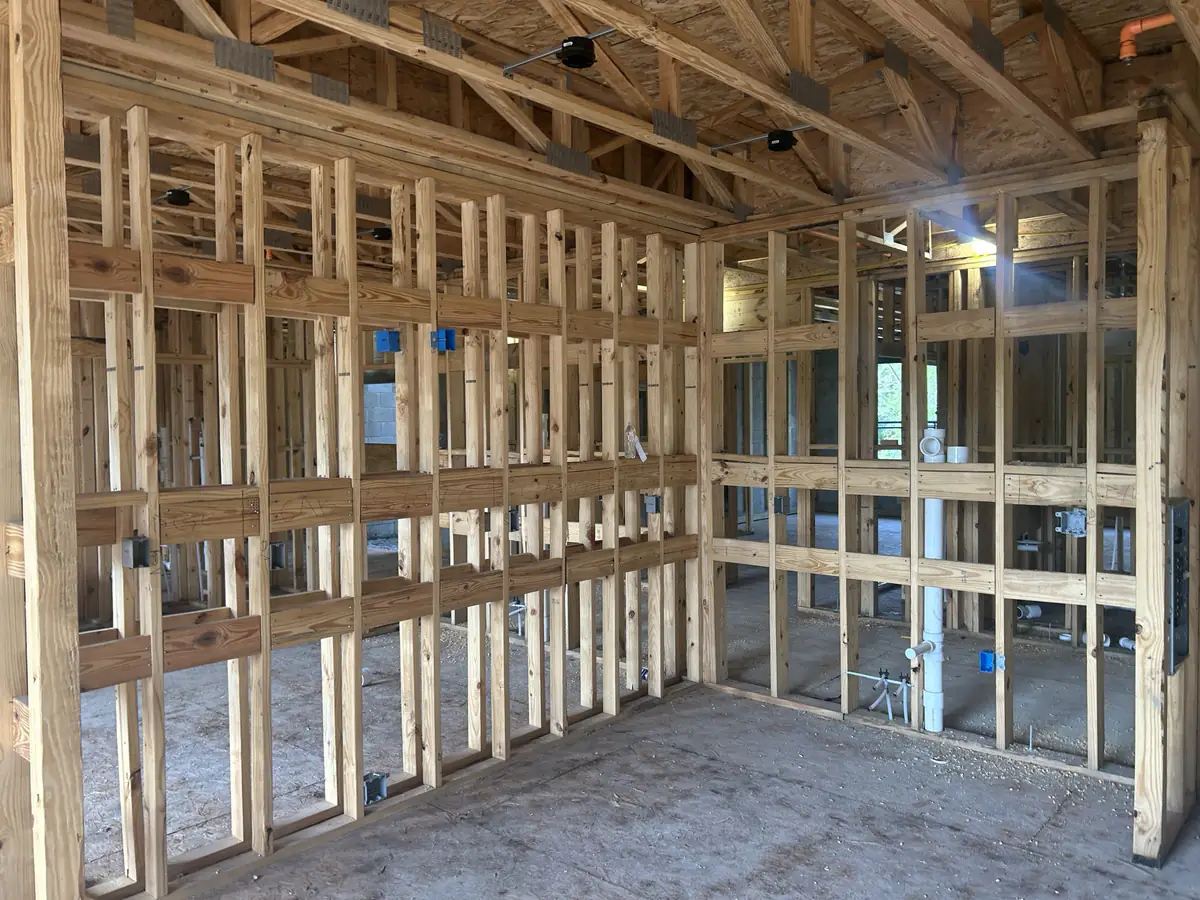
Walk a framed floor at Hawthorne Heights and you can read it off the studs. Blue device boxes nailed at a consistent height, four square boxes set where the taller devices land, and round boxes fixed to the trusses for the fans and ceiling lights. Above the floor trusses the orange conduit runs perpendicular to the joists, threaded past insulated flex duct and plumbing stacks that got there first. Yellow cable snakes back toward the panel location. None of it is complicated on its own. All of it is easy to get slightly wrong two hundred times in a row.
That is why box heights, stud drilling and plate protection get checked as a habit rather than at the end. A miss here becomes a drywall repair later, or worse, a failed inspection across an entire floor. The devices themselves, the outlets and switches, go in at trim. The light fixtures follow.
Before the slab, and often before the walls exist at all. On this site our crews were working in the footing trenches while the rebar was still being tied.
The gallery shows what that stage really looks like. A worker on his knees in a trench wiring a footing cage together with string lines strung above him. A bank of large gray PVC conduits laid in a wide trench and swept up toward the building line. Two workers running a plate compactor down a trench in lifts, because loose backfill under a future driveway is a callback waiting to happen. And a pair cutting under a finished concrete sidewalk to get a run across without breaking the walk, which saves a pour and roughly a week.
Do it in that order and the building follows. Do it out of order and everyone waits on you. Whether the site is here or anywhere else in Orange County, the sequence does not change.

We do, and it is one of the first things installed. Every other trade on a multifamily job runs off temporary power that the electrical contractor builds, feeds and maintains.
At Hawthorne Heights that meant weatherproof GFCI receptacle assemblies screwed to a plywood panel on a stud, fed with cord, positioned so the framers on one side and the plumbers on the other could both reach them without dragging a hundred feet of extension cord through the mud. Corridors got temporary lamps strung along the framing so work could continue once the light dropped behind the tree line. The compressors, the saws, the lifts and the drying fans after an afternoon storm all land on that same temporary system.
It also has to be safer than permanent work, not less safe, because it lives outdoors, gets moved constantly, gets stepped on and gets handled by people who are not electricians. That is why it is GFCI protected everywhere and why we inspect it rather than install it and forget it. Owners who want the finished building verified before turnover can book an electrical inspection.


We take multifamily projects from the footing trench through final trim, including the temporary power everyone else depends on. Call (407) 880-8977.