
VFD and Motor Control Upgrade at the Hunter's Creek Water Supply Facility
Drive and motor control work inside an operating Orange County water plant, plus the conduit, transfer switch and lighting around it.
Drive and motor control work inside an operating Orange County water plant, plus the conduit, transfer switch and lighting around it.

A water supply facility does not get to stop. That single fact decides how every electrical scope inside one is written, sequenced and inspected.
Hunter's Creek sits in south Orange County, and the plant that serves it looks like exactly what it is from the outside: two large ground storage tanks, a low block pump building, and a fenced yard with just enough room to swing a machine. Our work covered the drive and motor control installation the project is named for, along with the conduit and feeders supporting it, a transfer switch, and the lighting throughout the building. There is no soft version of the schedule here. A pump that is down is a pump that is not moving water to somebody kitchen tap, so outages get planned, kept short and worked to the minute. Utility work is the deep end of industrial electrical services, and it is a large part of what we do as an electrical contractor in Orange County.
A control cabinet, a way to switch sources, and a raceway system that will survive a wet, chemical environment for the next twenty years.
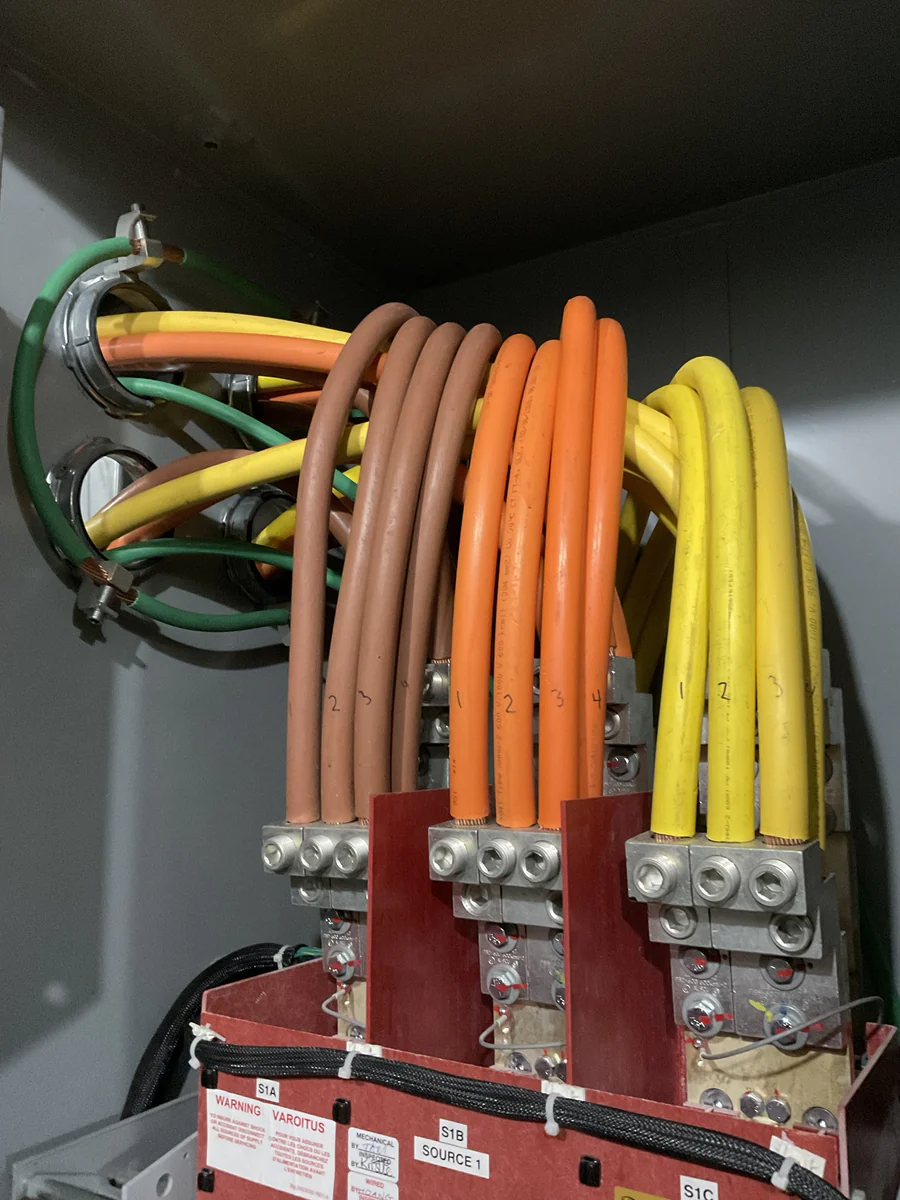
The gray cabinet in the gallery is the control side of it. Door mounted devices on the left, and on the back panel a field of contactors, overloads, terminal blocks and neatly loomed red control wiring running top to bottom. It arrived as a unit and got rigged into place on a chain hoist, which is its own small operation inside a building with a low roof and nowhere to maneuver. Beside it is the transfer switch, and that photo shows the part worth studying: brown, orange and yellow feeders landed in sets on a bus stack labeled S1A, S1B and S1C for Source 1, with the green grounds pulled off to one side.
Those colors are not decoration. Brown, orange and yellow is 480 volt three phase, the operating voltage this class of pump equipment lives on, and a very different animal from anything in a house. Backup power at this scale is the industrial cousin of the generator installations we do for businesses, and the package as a whole falls under commercial and institutional electrical work.

You cut into it. There is no clean way to route new raceway through a finished block structure, so you plan the openings, make them, and put the building back.
Several photos show our crew hand digging a trench inside the pump building, hard against the block wall, with PVC laid in and a green trench box staged beside it. That is interior underground, done with shovels and a hand tamp because there is no room for a machine and no tolerance at all for hitting something live. Another shows the slab poured back over it, conduit stub ups standing proud of fresh concrete while a power trowel finishes the surface behind them.
Above grade it is rigid galvanized conduit and a lot of it. It runs down the block walls to disconnects, out to a wall exhaust fan, over to the roll up door operator and across the underside of the roof deck on strut. Rigid is simply the right choice in a plant environment. Outside, a telehandler and a Takeuchi excavator set a precast pull box next to the storage tanks so the underground could carry on across the yard. Work of this type is also what our Orlando electricians handle on process and utility sites.

Because operators and maintenance crews have to read gauges, chase a fault and work safely in a room full of moving equipment, sometimes at three in the morning.
The lighting photos are some of the clearest in this gallery. Two techs on scissor lifts, one on a blue EquipmentShare GS-1932 and one on a JCB, hanging linear strip fixtures on aircraft cable from the roof structure and working around the yellow monorail beam that runs the length of the bay. Getting even coverage under a beam like that takes layout rather than luck, because the beam will drop a hard shadow line straight down the middle of the room if the fixtures are spaced badly.
There is a practical constraint the photos capture well too. Half the building was sheeted in plastic containment while other trades worked, so the lighting had to go up in whatever sections were open and get finished in passes. Commercial lighting installation inside an operating facility is always worked in pieces like this, never in one clean sweep.




We work around live process equipment, plan the outage windows and hit them. Call (407) 880-8977 to discuss your facility.