
Retail Service, Switchgear and Standby Generator at Lady Lake Market
Service gear, feeders, a standby generator and the site work underneath all of it, on a new retail build in Lady Lake.
Service gear, feeders, a standby generator and the site work underneath all of it, on a new retail build in Lady Lake.

Retail buildings look simple from the parking lot. The electrical room says otherwise.
Lady Lake Market went up as a new build, and the photos run from bare dirt and curb forms all the way through storefront signage and automatic doors on opening approach. The heart of the job is the room holding the ABB switchboard sections, where four reels of feeder sat on jack stands while a crew pulled conductor into open gear. Outside on a pad is a RavenVolt standby unit, set, blocked and terminated into the switchgear beside it. Between those two points sits most of what a store actually needs before it can trade. The building also has to be handed over on a fixed date, because a lease and a grand opening do not move for a punch list. This is commercial electrical construction at full scale, run by the same crews who work as electricians in Orlando and across Central Florida.
The service, the gear, the feeders and the life safety systems, roughly in that order, and every bit of it inspected.
The switchboard photos illustrate it best. One shows the ABB sections standing open while the crew feeds conductor in from reels of green, brown, yellow and orange. Another shows the inside of a section after the pull: a horizontal bus with the phases stamped A, B, C and N, brown, orange, yellow and gray conductors landed in sets on the lugs beneath it, and the vertical bus running down behind them. Brown, orange and yellow with gray as the neutral is 480Y over 277 volt gear, which is standard for a building this size because it moves the same power on smaller, cheaper conductors.
From there it branches out. Panels get set, the ceiling grid gets its boxes and whips, and MC cable gets pulled above the ceiling to feed everything in the sales area. Once the store is trading, those same systems need looking after, which is where electrical inspections and our 24/7 emergency service come in.

Because a grocery anchored store starts losing inventory the moment the power drops, and in Florida the power drops.
The white unit on the pad in the gallery is a RavenVolt Tier 4 Final package. One photo shows a member of our crew guiding it down onto its pad with red rigging straps still tensioned overhead and a corrugated pipe section sitting in the dirt beside it. Another shows a tech at the adjacent switchgear cabinet with a torque wrench and a driver resting on top of the enclosure while he lands orange, yellow and gray feeders onto stacked bus lugs. That cabinet is where the standby source and the normal source meet.
Setting a unit like that is a coordination job before it is an electrical one. The pad has to be poured and cured, the conduit has to be stubbed in exactly the right place, the rigging needs room to work, and every termination has to be torqued to spec rather than to feel. Much smaller versions of the same work are what we do on generator installations for businesses and homes.

Long, narrow and repetitive. Most of the exterior electrical on a retail site is conduit in a trench along a curb line, and most of it happens while everything else on the site is happening too.
The photos show a tech hand digging a trench that runs the length of the frontage between a new curb and the construction fence, a service van parked on fresh asphalt behind him. Machines do the bulk on a site like this, but the last stretch near a finished curb, a light base or an existing utility gets opened by hand, because the cost of hitting something is far higher than the labor saved by not.
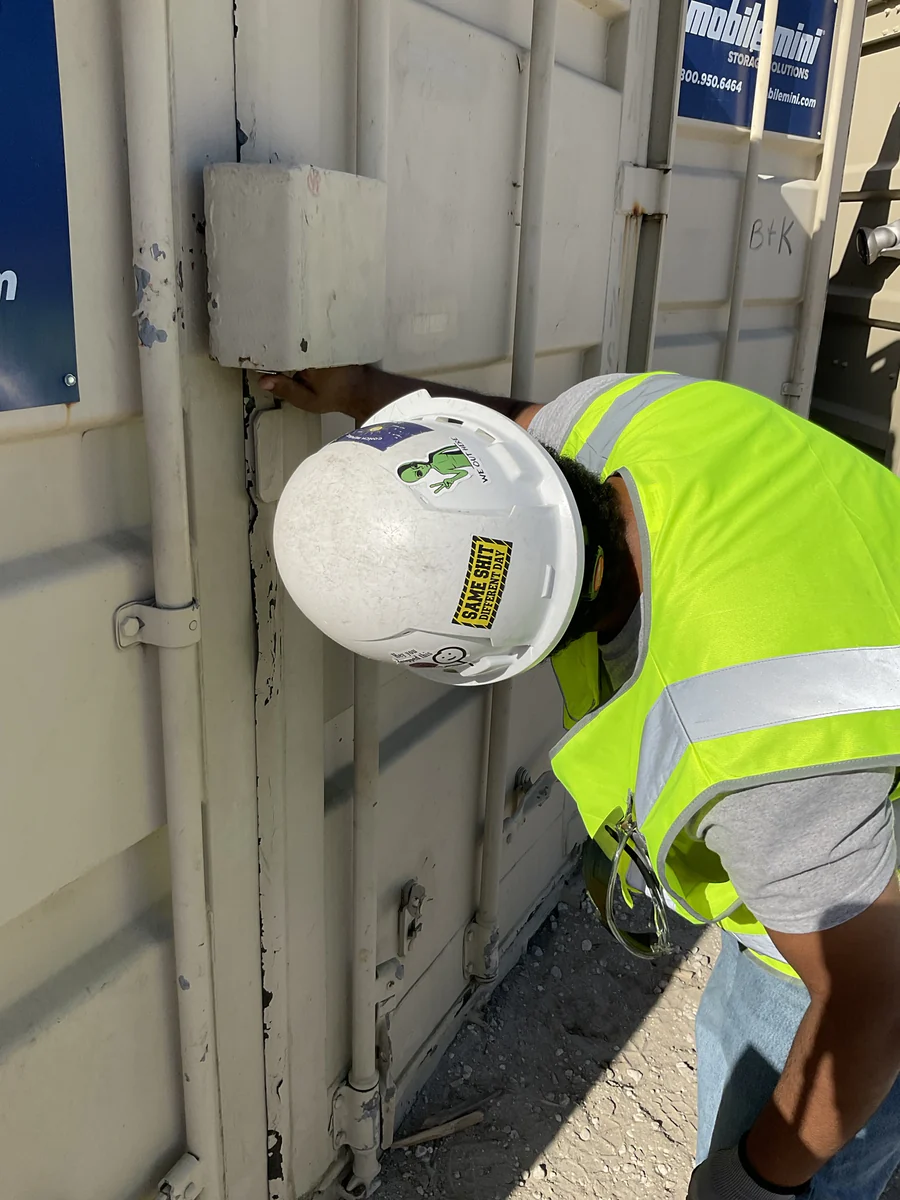
The rest of the site work is logistics. A JLG telehandler arriving on a lowboy trailer. Temporary power run out to Mobile Mini storage containers so the trailers and tool cribs have something to plug into. Canopy columns wrapped and protected while the sidewalk gets poured around them. None of that appears in the finished store, and all of it is why the finished store works. Similar scopes run through our industrial electrical division on larger sites.




From the service gear to the standby generator to the trench along the frontage, we deliver it as one scope on one schedule. Call (407) 880-8977.